Now for my third little piece today, a classic gangster film, and no, it's not the Godfather. Next up: The Public Enemy.
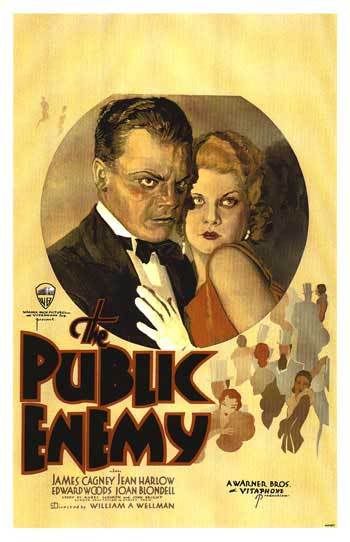
For a plot summary, we are watching the rise of Tom Powers, a Chicago criminal during Prohibition. He begins as a small time thief, rising with his friend Mike in their gang as Prohibition takes effect and the bootleg business grows. This is really a cautionary tale. There's even a warning at the opening and closing of the movie about how the movie doesn't glorify the actions of the characters, but serves as a call to action (hooray 1931 movie boards!)
Acting... Yay James Cagney!! 'Nuff said :)
No really, though. This was his first big leading role. And he wasn't even supposed to play the part of Tom! Up until almost the time shooting began, the two male leads were supposed to play the other part. According to one account, they were switched right before filming began because of another movie Cagney was in. He was stealing so many scenes as a minor character, they decided to cast The Public Enemy as a star vehicle for him. And this is one of those cases that yes, both leads are talented, but they are also so suited to their roles as it turned out, that you just can't imagine it the other way. It would have been a totally different movie!
James Cagney was barely 5'7" and still makes such an impact in this movie. Just walking in the door in his first scene, he makes his presence known. In the extras on the DVD, one of the interviewees used the line "Cagney walked through that door, and modern acting was born." It's true. This wasn't the first of his gangster movies of the 1930s and 1940s (he already had 2 under his belt), but it was the first major role and major budget, definitely establishing him as a talent. He is so memorable in this role too - the scene in the rain, going into the rival gang's headquarters, his expression is hard to forget. Almost downright psychotic!
Speaking of on-screen charisma, Jean Harlow plays one of Tom's girlfriends. You can tell it's an early role for her - she has a speech or two where the delivery is, well, a little odd. Still, there is something to be said for pure screen presence. You can tell that she'll become big, even in this small role.
The camera work is great in this one. It does a great job keeping (and in a lot of scenes enhancing) the dark and violent mood of the story, without actually showing anything on screen. You really only see one person get shot on film. Every other death is off screen, in shadows, etc. Putty Nose's death is a very good example. You see Tom pull out his gun, but then the camera pans away, focuses on Matt fidgeting at the doorway. You hear the shot, and Tom then joins him, talking about going back to the restaurant (like in Pulp Fiction, food and hits - makes the characters seem colder, that killing doesn't bother them anymore). It's so much more effective as a result - leaving things up to your imagination just makes them so much more effective, more impressive than what can be actually captured on screen.
There are so many scenes in this movie that have just become classic shots, mimicked or parodied in so many other forms. The grapefruit scene is in this one (Cagney pushing the grapefruit half into his girlfriend's face during an argument at breakfast). The final scene at the doorway. The scene where he walks into the rival gang's headquarters, walking across the street from under the lamp, walking through the rain, his coat collar turned up. If you don't know the scene from my description here, you'd recognize it if you saw it. There are just some scenes from movie history that are iconic, the ones that end up in every film clip montage on every Top 100 list. This is one of those scenes. And this movie is chock-full of those. It's worth it to watch the movie simply to see where more modern movies are taking their inspiration from!
Yes, it is a little ham-handed at times (Tom falling down shot, in the gutter, in the rain - so much symbolism, your teeth hurt, to mix metaphors) But, you have to take into account that it was 1931 when the movie was made. In the framework of it's time period, this was just an incredible movie. And that people are still looking at it today, both for inspiration and on its own merits, says something indeed.
Overall: 5 of 5. A classic for a reason. See it, if for no other reason than to see what inspired more modern movies like the Godfather and Goodfellas.
Acting... Yay James Cagney!! 'Nuff said :)
No really, though. This was his first big leading role. And he wasn't even supposed to play the part of Tom! Up until almost the time shooting began, the two male leads were supposed to play the other part. According to one account, they were switched right before filming began because of another movie Cagney was in. He was stealing so many scenes as a minor character, they decided to cast The Public Enemy as a star vehicle for him. And this is one of those cases that yes, both leads are talented, but they are also so suited to their roles as it turned out, that you just can't imagine it the other way. It would have been a totally different movie!
James Cagney was barely 5'7" and still makes such an impact in this movie. Just walking in the door in his first scene, he makes his presence known. In the extras on the DVD, one of the interviewees used the line "Cagney walked through that door, and modern acting was born." It's true. This wasn't the first of his gangster movies of the 1930s and 1940s (he already had 2 under his belt), but it was the first major role and major budget, definitely establishing him as a talent. He is so memorable in this role too - the scene in the rain, going into the rival gang's headquarters, his expression is hard to forget. Almost downright psychotic!
Speaking of on-screen charisma, Jean Harlow plays one of Tom's girlfriends. You can tell it's an early role for her - she has a speech or two where the delivery is, well, a little odd. Still, there is something to be said for pure screen presence. You can tell that she'll become big, even in this small role.
The camera work is great in this one. It does a great job keeping (and in a lot of scenes enhancing) the dark and violent mood of the story, without actually showing anything on screen. You really only see one person get shot on film. Every other death is off screen, in shadows, etc. Putty Nose's death is a very good example. You see Tom pull out his gun, but then the camera pans away, focuses on Matt fidgeting at the doorway. You hear the shot, and Tom then joins him, talking about going back to the restaurant (like in Pulp Fiction, food and hits - makes the characters seem colder, that killing doesn't bother them anymore). It's so much more effective as a result - leaving things up to your imagination just makes them so much more effective, more impressive than what can be actually captured on screen.
There are so many scenes in this movie that have just become classic shots, mimicked or parodied in so many other forms. The grapefruit scene is in this one (Cagney pushing the grapefruit half into his girlfriend's face during an argument at breakfast). The final scene at the doorway. The scene where he walks into the rival gang's headquarters, walking across the street from under the lamp, walking through the rain, his coat collar turned up. If you don't know the scene from my description here, you'd recognize it if you saw it. There are just some scenes from movie history that are iconic, the ones that end up in every film clip montage on every Top 100 list. This is one of those scenes. And this movie is chock-full of those. It's worth it to watch the movie simply to see where more modern movies are taking their inspiration from!
Yes, it is a little ham-handed at times (Tom falling down shot, in the gutter, in the rain - so much symbolism, your teeth hurt, to mix metaphors) But, you have to take into account that it was 1931 when the movie was made. In the framework of it's time period, this was just an incredible movie. And that people are still looking at it today, both for inspiration and on its own merits, says something indeed.
Overall: 5 of 5. A classic for a reason. See it, if for no other reason than to see what inspired more modern movies like the Godfather and Goodfellas.






















No comments:
Post a Comment