So we watched this actually back in early June (was the mini-series that drove Zach to ask us to upgrade my Netflix account! "You and your British shows" I believe was the quote) but I had the book on my shelf too. And so after watching the miniseries, I decided to read the book as well, as I hadn't yet. So, a double review here, A Perfect Spy, both book and mini-series - that's how I justify to myself, having a movie review on Thursday instead of Monday :)

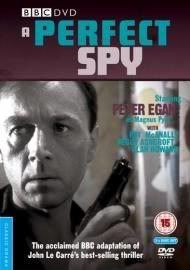
You'll laugh at this, but the reason I had purchased the book in the first place was because Dad had it on our shelf at home. Also had Tinker, Tailor, Soldier, Spy and another Le Carre which I can't remember now, but I remember looking at the shelf when I was little and seeing those books. The bright red and yellow dust jacket on A Perfect Spy (pictured above left) is hard to forget. Then while I was in SC, I went to the local library system's Used Book Sale and found the same edition there for sale. Sunday at the Book Sale was 1/2 Price, so already inexpensive books were even cheaper- I made out like a bandit!!! Since A Perfect Spy was about a buck, I decided it was worth it as a silly reminder of home. (Yes, I was incredibly homesick in SC, and Horrible Job didn't make it any easier, so I appreciated any reminder of home during my time there!)
So, yes, now that I have both read the book and watched the miniseries, here are my thoughts. :)
For both, the plot is the same. This was a miniseries that reflected the book very well - no crazy additions or alterations to make the story "better," according to movie standards. BBC has done very good jobs with several John Le Carre works. I LOVE Tinker, Tailor, Soldier, Spy with Alec Guinness, and Smiley's People, also with Guinness, was another great one. The whole story of A Perfect Spy revolves around Magnus Pym, a senior spy in Britain's Eastern Europe set-up, who has turned up missing from his post. He has been a double agent for the majority of his career, thriving on betrayal and reinvention of himself. Now, Pym has reached a crisis in his life, and has retreated into his past, looking back at those events and people who taught him about betrayal, lies, deceptions, and all those other features that have made him into a Perfect Spy.
The book was very long, but very good. I always tried to read at least a little before bed, if I couldn't squeeze in more in the day. I know that in how I've described it above, it sounds like some boring had-to-read-in-high-school, search-for-self sort of stories, but it's much more interesting than that. It's set in a spy chase. We don't know exactly how much Pym has done, how deep his betrayal is, who's going to catch him first (the British or the Czech). It's not a spy-story like James Bond, but Le Carre never is. No explosions, no car chases, no master villains with laser cannons, but spy stories nonetheless.
I liked the mini-series, but I don't think it's one for the shelf. It's very true to the book, which I really liked, in retrospect, because it gave the story all the layers it needed. At the same time, however, the miniseries could become almost painfully slow. It is paced very very slowly, and understandably, since so many events in Pym's lifetime need to be included to understand how he arrives where he is at the end of the story. One of the tricks he used in the book to overcome any slowing of the story was to hop around in time. The book begins with the same scene as the movie, with Pym's pursuers closing in. In the book, however, we return to that time over and over, interspersing scenes of his pursuers with scenes of Pym's reflections, until everything draws to a simultaneous close. In the movie, we are introduced in that scene, but then follow Pym's life straight through until we arrive back at the opening scene in time for the finale.
The other aspect of the book I missed in the movie was the characters' thoughts. There was a lot of Pym's formation as a spy that was internal - you can see the events in the movie, but you are losing out on the thought process involved. A lot of Pym's reactions, his molding of himself to suit the different situations he found himself in, his attempts to be exactly what everyone needed of him, no matter how conflicting those roles are... these are very important aspects of Pym's development, but can only be handled superficially in a filmed format (filmed monologuing can quickly become cartoon-villain like). And it wasn't just Pym's thoughts I missed - almost all the characters had train of thought sections. It gave a well-rounded view of how Pym arrived at where it was, as well as adding suspense to the story (two of his pursuers were ones whose thoughts were displayed regularly, as they tried to figure out who and how much he had betrayed and where he had then disappeared to).
Overall:
The miniseries: 3.5 of 5. Very well done, some beautiful scenery and wonderful acting, but I don't think I'll get it for the shelf, though. When I want to revisit these characters, I'll pick up the book instead.
The book: 5 of 5. A great read. Was very hard for me to put down at times. You don't necessarily like the main character, but it's more an absence of liking, rather than a dislike. He makes an interesting study, I suppose - he's lying and deceiving, but in a search for self, for love. You are drawn in, trying to understand him as he's trying to understand himself, all in the setting of a spy chase. Was a very interesting read.
For both, the plot is the same. This was a miniseries that reflected the book very well - no crazy additions or alterations to make the story "better," according to movie standards. BBC has done very good jobs with several John Le Carre works. I LOVE Tinker, Tailor, Soldier, Spy with Alec Guinness, and Smiley's People, also with Guinness, was another great one. The whole story of A Perfect Spy revolves around Magnus Pym, a senior spy in Britain's Eastern Europe set-up, who has turned up missing from his post. He has been a double agent for the majority of his career, thriving on betrayal and reinvention of himself. Now, Pym has reached a crisis in his life, and has retreated into his past, looking back at those events and people who taught him about betrayal, lies, deceptions, and all those other features that have made him into a Perfect Spy.
The book was very long, but very good. I always tried to read at least a little before bed, if I couldn't squeeze in more in the day. I know that in how I've described it above, it sounds like some boring had-to-read-in-high-school, search-for-self sort of stories, but it's much more interesting than that. It's set in a spy chase. We don't know exactly how much Pym has done, how deep his betrayal is, who's going to catch him first (the British or the Czech). It's not a spy-story like James Bond, but Le Carre never is. No explosions, no car chases, no master villains with laser cannons, but spy stories nonetheless.
I liked the mini-series, but I don't think it's one for the shelf. It's very true to the book, which I really liked, in retrospect, because it gave the story all the layers it needed. At the same time, however, the miniseries could become almost painfully slow. It is paced very very slowly, and understandably, since so many events in Pym's lifetime need to be included to understand how he arrives where he is at the end of the story. One of the tricks he used in the book to overcome any slowing of the story was to hop around in time. The book begins with the same scene as the movie, with Pym's pursuers closing in. In the book, however, we return to that time over and over, interspersing scenes of his pursuers with scenes of Pym's reflections, until everything draws to a simultaneous close. In the movie, we are introduced in that scene, but then follow Pym's life straight through until we arrive back at the opening scene in time for the finale.
The other aspect of the book I missed in the movie was the characters' thoughts. There was a lot of Pym's formation as a spy that was internal - you can see the events in the movie, but you are losing out on the thought process involved. A lot of Pym's reactions, his molding of himself to suit the different situations he found himself in, his attempts to be exactly what everyone needed of him, no matter how conflicting those roles are... these are very important aspects of Pym's development, but can only be handled superficially in a filmed format (filmed monologuing can quickly become cartoon-villain like). And it wasn't just Pym's thoughts I missed - almost all the characters had train of thought sections. It gave a well-rounded view of how Pym arrived at where it was, as well as adding suspense to the story (two of his pursuers were ones whose thoughts were displayed regularly, as they tried to figure out who and how much he had betrayed and where he had then disappeared to).
As for other aspects of the miniseries, they are exceptional. It is brilliantly casted. I didn't much care for Peter Egan as the lead, honestly - he just wasn't as charismatic as Pym needed to be. Not that he was bad in the role, but he was just missing that something, and that was one character description which was repeated often in the book, how Pym could make anyone laugh, make anyone love him. Egan just didn't have that quality. The rest of the cast was awesome, though. Alan Howard as Jack Brotherhood (Pym's mentor and British controller) was exactly as the book has written him, only missing the white hair. And Rudiger Weigang was perfect as Axel (Pym's Czech controller). Weigang even has the look of Axel, as described in the book. Ray McAnally played Pym's con-man father, and was another awesome casting move. He has the charisma to seem a believable charmer, the characteristic Egan lacked. To give you an idea of how well these three actors suited their roles, in reading the book, I was hearing their voices in my head. Didn't quite have that from Egan's performance. That's always a good sign for me in how well a actor suits a role from a book I love :)
Overall:
The miniseries: 3.5 of 5. Very well done, some beautiful scenery and wonderful acting, but I don't think I'll get it for the shelf, though. When I want to revisit these characters, I'll pick up the book instead.
The book: 5 of 5. A great read. Was very hard for me to put down at times. You don't necessarily like the main character, but it's more an absence of liking, rather than a dislike. He makes an interesting study, I suppose - he's lying and deceiving, but in a search for self, for love. You are drawn in, trying to understand him as he's trying to understand himself, all in the setting of a spy chase. Was a very interesting read.






















No comments:
Post a Comment